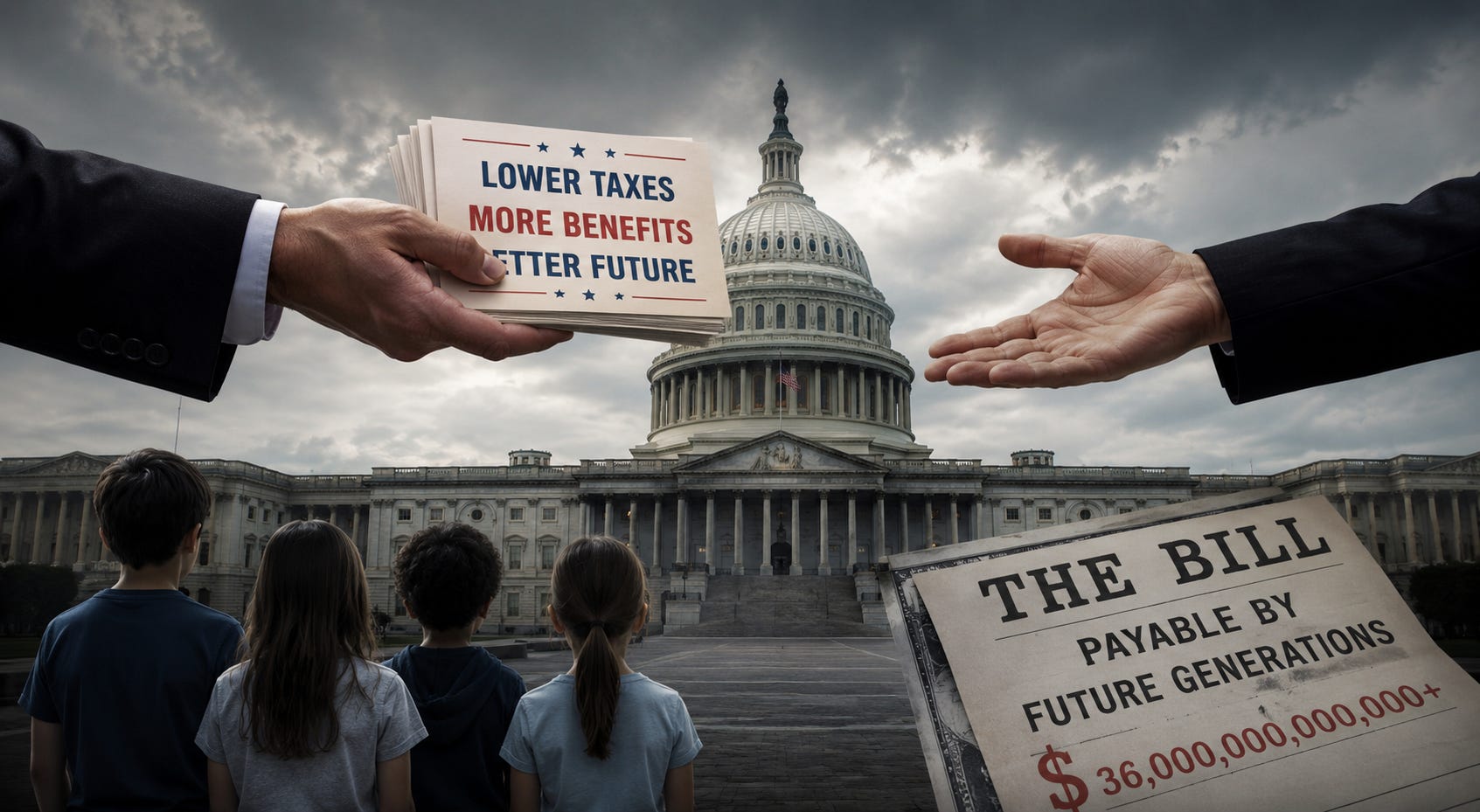
In Washington, fiscal honesty is rarely rewarded. Politicians promise lower taxes, higher spending, or both. Voters hear what they want to hear. The bill arrives later. Usually decades later.
That is the uncomfortable thesis advanced by Jessica Riedl, a long-time budget expert who has spent more than two decades moving through conservative think tanks, Capitol Hill and policy circles in Washington. In a wide-ranging conversation on Freakonomics Radio with Stephen Dubner, Riedl argued that America’s fiscal crisis is no longer a distant risk. It is already embedded in the country’s politics, tax system and entitlement structure.
Her central claim is blunt: almost everything Americans believe about taxes is wrong.
The politics of the “free lunch”
Riedl’s critique spares neither Republicans nor Democrats. Conservatives, she says, exaggerate the economic power of tax cuts. Liberals exaggerate how much money can be extracted from corporations and the wealthy.
Republicans have long argued that lower taxes stimulate enough economic growth to offset lost revenue. This is the famous “tax cuts pay for themselves” argument. Riedl dismisses it as fantasy. Tax cuts may generate some additional growth, she says, but historically they do not come close to fully financing themselves.
Another conservative belief is what economists call “starve the beast”: cut taxes, deprive government of revenue and politicians will be forced to cut spending. Yet Riedl notes that the opposite has often happened in America. Taxes fall, spending rises and deficits expand.
Democrats, meanwhile, tell a different but equally convenient story. According to this narrative, America’s deficits exist because the rich and corporations are undertaxed. Raise taxes on billionaires, and the fiscal problem disappears.
Riedl argues that the numbers do not support this either.
Even confiscatory taxes on the ultra-rich would barely dent America’s long-term deficit problem. Seizing all billionaire wealth, she argues, would fund only a fraction of federal spending, and only once. Meanwhile, America already operates one of the most progressive tax systems in the developed world, particularly in income taxation.
Her criticism is less ideological than arithmetic. The scale of future spending obligations is simply too large.
The debt machine
The figures are staggering. America’s national debt now exceeds $39trn, roughly 124% of GDP. Interest payments alone are approaching $1trn annually and are projected to climb sharply over the coming decades.
Riedl believes the fundamental driver is not taxation but spending.
Since 2000, federal spending has expanded dramatically, fuelled by wars, stimulus programmes, healthcare obligations and demographic ageing. Politicians from both parties, she argues, abandoned the fiscal restraint that briefly emerged in the 1990s when balanced budgets became politically fashionable.
Today, neither side campaigns seriously on discipline. Republicans favour tax cuts without corresponding spending reductions. Democrats support spending expansions without matching tax increases. Both postpone the consequences.
Riedl describes Washington as trapped in a dangerous equilibrium: politicians know the system is unsustainable but believe voters will punish anyone who speaks honestly about sacrifice.
The result is a bipartisan addiction to deficits.
The third rail: Social Security and Medicare
The interview becomes most politically explosive when the discussion turns to entitlement reform.
In American politics, few issues are more sensitive than Social Security Administration and Centers for Medicare & Medicaid Services. Yet Riedl argues that meaningful fiscal reform is impossible without changes to both.
Contrary to popular belief, Social Security and Medicare are not fully self-financing. Current workers fund current retirees. As populations age and birth rates decline, the worker-to-retiree ratio deteriorates.
Riedl estimates that Social Security and Medicare together face a long-term financing shortfall of roughly $124trn over 30 years.
Her proposed remedies are politically hazardous but economically conventional: gradually raise eligibility ages, increase taxes and reduce benefits for wealthier retirees through means-testing.
That final proposal is especially controversial. Millionaires, she argues, continue receiving generous Social Security benefits despite not needing them financially. Yet even discussing reductions for affluent retirees can trigger fierce political backlash.
The paradox is striking. Privately, many lawmakers acknowledge the problem. Publicly, few dare address it.
America versus Europe
One of Riedl’s more provocative claims concerns middle-class taxation.
She argues that Americans, especially middle-income earners, are taxed relatively lightly compared with Europeans. In much of Europe, governments finance extensive welfare states through broad-based consumption taxes such as VATs, along with heavier payroll taxes.
In the United States, by contrast, the federal income-tax burden is concentrated heavily among top earners. According to the data she cites, the top 20% of earners account for the overwhelming majority of federal income-tax revenue.
This distinction matters because many Americans admire European-style public services while opposing the tax structure that funds them.
Riedl’s argument is not necessarily that America should adopt Europe’s system. Rather, she believes fiscal debates should at least acknowledge the trade-offs honestly.
Large welfare states require large tax bases. Taxing only the rich is insufficient.
Trump, Biden and fiscal continuity
Although American politics often frames elections as radical breaks from the past, Riedl sees more continuity than difference.
She criticises Joe Biden for large spending increases, expansive stimulus measures and policies that contributed to inflationary pressures. But she is equally critical of Donald Trump, particularly his combination of tax cuts, tariff policies and reluctance to touch entitlement spending.
Her criticism of Trump’s second administration is especially severe. Programmes such as DOGE, the now-defunct Department of Government Efficiency initiative associated with Elon Musk, focused heavily on symbolic culture-war targets while leaving the largest spending categories untouched.
For Riedl, this reflects a broader truth about modern fiscal politics: headline-grabbing gestures are easier than structural reform.
The deeper problem
What makes Riedl unusual in Washington is not merely her fiscal conservatism. It is her insistence on criticising both tribes equally.
That has come at a cost. She jokes in the interview that she has few friends in Washington because her work involves “sharing uncomfortable truths”. Yet that independence also explains why her analysis attracts attention across ideological lines.
Her broader warning extends beyond taxes. America’s political system increasingly rewards emotional narratives over numerical reality. Tax myths persist because they tell voters what they want to hear.
Conservatives are told tax cuts are painless. Progressives are told billionaires can finance everything. Both stories avoid sacrifice.
But debt compounds regardless of ideology.
Riedl ultimately believes the mathematics will prevail. The only uncertainty is whether reform happens gradually through political compromise, or suddenly through crisis.
For now, Washington appears content to delay the reckoning.