
Every technological revolution creates winners and losers at different stages of its life cycle. The dotcom boom is the textbook case: internet adoption went on to transform the economy, yet many of its earliest champions vanished long before the transformation was complete. Artificial intelligence looks set to follow a similar arc. The question worth asking is not simply whether AI will boom or bust, but who, exactly, stands to gain or lose at each stage -- and whether India’s answer looks like America’s.

A layered view of the cycle
The table below summarises how each layer of the AI value chain behaves during the boom and bust phases, and where long-term winners are most likely to emerge.
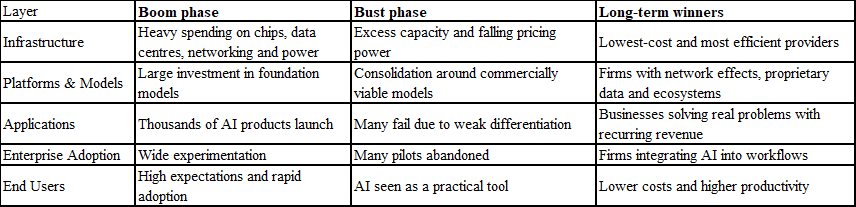
A useful way to analyse any AI investment is to separate the value chain into layers, each with its own boom and bust dynamics.
Infrastructure -- chips, data centres, networking and power -- sees heavy spending during the boom and, in a bust, excess capacity and falling pricing power; the eventual winners are the lowest-cost, most efficient providers. Platforms and foundation models attract enormous investment early on, before consolidating around the handful that prove commercially viable, favouring firms with network effects, proprietary data and developer ecosystems. Applications multiply by the thousand in the boom phase and fail in droves once the bust exposes a lack of differentiation; survivors tend to be businesses solving real problems with recurring revenue. Enterprise adoption follows a similar pattern of wide experimentation followed by abandoned pilots, rewarding firms that actually weave AI into existing workflows. End-users, finally, move from sky-high expectations to the sober realisation that AI is a tool rather than a miracle -- benefiting, in the end, from lower costs and higher productivity.
Five questions help sort the durable from the fashionable. Where does a company sit in the value chain -- chipmaker, cloud provider, data-centre operator, software firm or AI-enabled business -- since each faces different economics? Is demand structural or merely cyclical: data generation and computing needs look structural, whereas buying GPUs ahead of demand may not be. Who captures the economics, given that technological adoption does not always reward the technology’s creators -- electricity generated enormous value even as utilities earned only regulated returns, and the internet enriched users more than most telecoms firms? Does AI strengthen or weaken a firm’s competitive position, boosting those with proprietary data, distribution and loyal customers while eroding businesses whose knowledge can be commoditised? And what happens if capital becomes expensive, since booms typically end when financing conditions tighten and cash flow, not funding rounds, decides who survives?
Historically, this cycle unfolds in four phases: an infrastructure boom (benefiting chipmakers, equipment suppliers and data-centre operators, at the risk of overbuilding); an application explosion (thousands of start-ups, high valuations, little differentiation); a shake-out (falling valuations, consolidation, bankruptcies -- the phase in which the strongest companies typically emerge); and finally a productivity era, in which AI becomes invisible infrastructure and the biggest beneficiaries may not even call themselves AI companies. Railways, electricity, the internet and smartphones all followed variants of this pattern; in each case the lasting wealth accrued not to the miners but to the suppliers of picks and shovels, and to the “towns” that grew up around the goldfields using the new technology to work more efficiently.
Why India will not simply mirror America
This framework travels well. But applying it to India requires adjusting for three features of the Indian economy that have no close American equivalent.
Retail investors could cushion market volatility. India’s equity markets have changed dramatically over the past decade. Millions of households now invest regularly through Systematic Investment Plans, making them an increasingly important source of market liquidity. Annual SIP contributions have risen from under ₹44,000 crore in FY2016–17 to nearly ₹3.5 lakh crore in FY2025–26, and these inflows held up through both the pandemic and subsequent corrections (AMFI, 2026) -- evidence that retail investors have become long-term participants rather than short-term traders. At the same time, direct retail trading now accounts for a smaller share of daily turnover than it once did, as more investors favour mutual funds over individual shares and institutional and algorithmic trading grows (Whalesbook, 2026). The implication is nuanced: an AI-driven correction could still make day-to-day trading choppier, but steady SIP inflows may continue to underpin equity markets, limiting the depth of any prolonged sell-off -- a shock absorber American markets largely lack.
The Reserve Bank has less room to manoeuvre. Where the Federal Reserve can often cut rates aggressively in a slowdown, the Reserve Bank of India must also defend exchange-rate stability and guard against imported inflation. A global AI-driven slowdown could trigger capital outflows from emerging markets and weaken the rupee; a weaker currency would raise the cost of imported oil, electronics and industrial inputs, pushing inflation up even as growth slows. In that scenario the RBI might struggle to cut rates at all, meaning an AI bust could tighten financial conditions in India precisely when the economy needs support -- a far more constrained position than that of advanced-economy central banks.
India’s biggest exposure is as an exporter of talent. For America, AI is chiefly about lifting domestic productivity. For India, it also threatens one of the country’s largest export industries. The IT services and business-process-management sectors employ millions of professionals doing precisely the kind of routine knowledge work -- documentation, coding support, customer service, research assistance, report preparation -- that generative AI is designed to automate. The evidence so far is mixed: NASSCOM reckons AI could add nearly $621bn to India’s economy over time and expects the technology to transform jobs rather than eliminate them, and surveys suggest most employers are redesigning roles rather than cutting headcount (NASSCOM, 2026b; Enterprise Times, 2026), while the RBI has noted that IT services exports remain resilient despite growing concern about AI (New Indian Express, 2026). The deeper risk may be slower to show. If companies keep hiring fewer graduates while leaning more on AI, India’s talent pipeline could thin out gradually, since junior staff typically learn by doing routine work before taking on more complex responsibilities. Shrinking entry-level opportunities today could mean a shortage of experienced professionals a decade from now -- a lag effect that would not show up in this year’s export figures.
What each scenario would mean for India
A boom would lift productivity across manufacturing and services, expand Global Capability Centres, draw fresh investment into the digital economy and push technology firms further up the value chain, boosting demand for AI specialists, cybersecurity professionals and cloud engineers. Consumers would gain from better AI-powered healthcare, education, financial services and public administration. But the gains would not be shared evenly: workers with advanced digital skills would capture a disproportionate share, while routine knowledge jobs would come under mounting pressure.
A bust would look different from a Wall Street correction. Investment in data centres and AI infrastructure could slow sharply, straining the banks that finance such projects. States with already-stretched finances would find it harder to sustain employment if tax revenues weakened. The RBI would have limited room to help if capital outflows hit the rupee and stoked imported inflation. Most consequentially, India’s IT services industry could see slower growth if global clients cut spending on AI and digital transformation. Where American markets might absorb much of the adjustment through asset prices, India’s risks would be spread across banks, state governments and the labour market itself.
The bottom line
The boom-or-bust framework -- infrastructure, platforms, applications, enterprise adoption, end-users; structural versus cyclical demand; who captures the economics -- remains a useful lens for thinking about AI’s future anywhere. But India’s story will not simply mirror America’s. A young workforce, a large informal economy, a bank-led financial system and a globally competitive IT services industry give the country its own distinct set of opportunities and risks. A boom could accelerate productivity, strengthen exports and support long-term growth; a bust would expose structural weaknesses in employment, state finances and bank lending rather than trigger the market dynamics familiar from developed economies.
For investors and policymakers, the lesson is straightforward: analyse AI in India through India’s own economic realities, not assumptions borrowed from elsewhere. The technology may be global. Its consequences will remain deeply local.
References
Association of Mutual Funds in India. (2026). SIP contribution data.
Business Today. (2026). IT industry likely to hire 135,000 employees in FY26, projects Nasscom.
Enterprise Times. (2026). Top skills employers prioritise in 2026 as AI redefines jobs across industries.
Ministry of Finance, Government of India. (2026). Union Budget 2026–27.
NASSCOM. (2026a). India’s services sector and the AI opportunity.
NASSCOM. (2026b). India’s workforce transformation opportunity in the AI era.
New Indian Express. (2026). Reserve Bank of India says IT services exports resilient despite growing AI concerns.
Press Information Bureau. (2025). Periodic Labour Force Survey Annual Report.
PRS Legislative Research. (2025). State of State Finances.
Rees, D. (2025). AI economic scenarios: Revolutionary growth, or recessionary bubble?