
Financial statements are the only place in business where everyone — founder, investor, regulator, competitor — must speak the same truth. Markets can over-value, media can over-celebrate, and leadership can over-promise, but the numbers continue recording the company as it exists, not as it markets itself. Learning to read them is not a specialist pursuit; it is a clarity pursuit. It gives you the ability to stay calm while everyone else reacts to headlines, valuations, and quarterly excitement.
At their simplest, financial statements reveal three questions every business must eventually answer:
● Can it earn money consistently?
● Can it pay what it owes and survive?
● Does its cash flow match its success story?
Nothing else—brand perception, market personality, investor hype—can substitute for those answers.
What They Actually Reveal
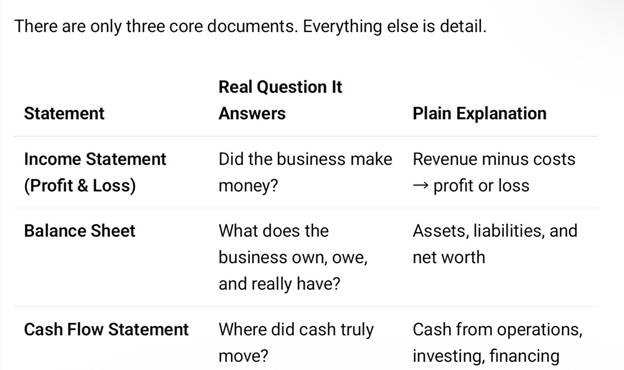
The income statement tells you whether the business is profitable, but more importantly, how it became profitable. That detail matters. A company can post earnings without improving its actual business performance, through asset sales, accounting timing, or temporary incentives. Profit is not a yes/no status; it is a quality question.
The balance sheet answers something quieter but more lasting: safety. What does the company own that will continue to support it, and what obligations threaten to bend it? A business may be celebrated for high revenue, but if it is built on heavy borrowing, delayed payables, or thin reserves, the celebration is precarious.
The cash flow statement then cuts through every interpretation. Cash does not report ambition, story, or vision. It reflects discipline. It shows whether the operations generate actual liquidity, whether investments eat more than they return, and whether financing is support or dependence.
Together, they form not just a financial portrait but a behavioral one.
Who Uses Them (And What Happens When They Don’t)
Financial statements aren’t just numbers; they are signals, often ignored at great cost. Investors who overlooked GameStop’s rapid cash burn in 2020 were caught by surprise when reality hit, losing money almost instantly. SoftBank poured $18 billion into WeWork, dazzled by the narrative and expansion story, only to see cash flow tell a very different tale. Banks that lent to Evergrande relied on headline revenue growth and missed the $300 billion debt mountain quietly accumulating on the balance sheet. On the other hand, retail investors who studied Tesla’s 10-K in 2018 noticed that Model 3 production cash was finally turning positive—they acted early and profited massively, achieving a 20× gain.
These examples illustrate a single truth: if you don’t read financial statements, you are betting on stories; if you do, you are reading reality.
An Example That Says Enough
Consider WeWork. It positioned itself not as a leasing operation but as a reimagining of work culture. For months, the story carried valuation and investor appetite effortlessly. Yet one glance at its cash flow would have neutralized the momentum. The burn rate was not trending toward efficiency; it was accelerating. Lease obligations committed it to years of fixed payouts, while revenue remained flexible and seasonal. The financial statements did not contradict the narrative—they simply reminded readers that narrative does not pay rent. When correction finally arrived, the numbers had been patient, visible, and consistent.
Why They Matter – Punchy Truths
Beautiful pitch decks and charismatic founders cannot replace honest numbers. Companies like Theranos, Nikola, Luckin Coffee, and Enron all dazzled investors with visions of the future—but their financial statements were either nonexistent or misleading. In contrast, companies like Apple, Costco, and NVIDIA quietly built massive real-world value, reflected in clean, steadily growing numbers that created trillions in actual wealth.
The same skill—reading and interpreting financial statements—lets you value anything from a small street vada pav cart to a $2 trillion tech giant. It is the common language that Warren Buffett, Cathie Wood, loan officers, and future employers all speak fluently. Mastering it gives you a lens through which hype becomes visible, risk becomes measurable, and opportunity becomes actionable.
Seeing the Full Picture: How the Statements Connect
Financial statements are most powerful when read together, because each tells part of the story. The income statement reveals profitability, the balance sheet shows what a company owns and owes, and the cash flow statement tracks real money movement. Alone, each is informative; together, they provide a complete view of health, risk, and performance.
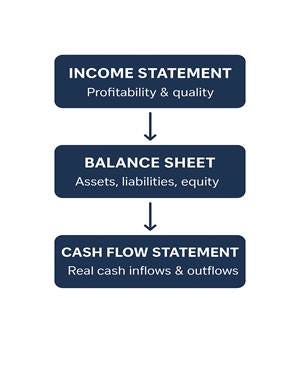
Reading them together lets you spot trends and red flags early. Profit on paper might look strong, but declining cash flow can warn of future trouble. A balance sheet may show assets, but heavy debt could constrain flexibility. By connecting the dots, you see not just what a business has done, but how sustainably it is creating value.
Bottom Line
Financial statements are the one place where business simplicity and business complexity meet. They allow you to see beyond valuation, beyond charisma, beyond quarterly celebration. They teach reflection instead of reaction. And most importantly, they give you the ability to identify whether a company is actually creating value or merely performing it.
Once you can read them, confidence stops being external. It becomes derived, independent, almost quiet. And in a market built on noise, quiet confidence is the advantage.