
For years, Market-Linked Debentures (MLDs) were sold to India’s wealthy investors on a simple pitch: equity-like returns taxed like debt. That pitch collapsed in April 2023. Yet MLDs have not disappeared from portfolios — if anything, interest in them has held up. The reason is that the investment case has quietly been rebuilt on different foundations.

The tax advantage that vanished
MLDs are hybrid instruments — non-convertible debentures whose final payout is tied to the performance of a market benchmark, such as the Nifty 50, Sensex, gold, or a government-bond yield, rather than to a fixed coupon. Some are “principal-protected,” guaranteeing the return of capital regardless of how the benchmark performs; others put the principal itself at risk.
Until 2023, the appeal was mostly fiscal. MLDs held for more than 12 months qualified for long-term capital gains tax at a flat 10%, well below the slab rates applied to interest income from ordinary bonds or fixed deposits. That made them a favourite of high-net-worth individuals (HNIs) looking to dress up equity-like returns as tax-efficient debt.
The Finance Act 2023 ended this. A new provision, Section 50AA, reclassified all MLD gains as short-term capital gains, taxable at the investor’s slab rate — as high as 30% plus surcharge for top earners — irrespective of how long the instrument is held. There was no grandfathering: even MLDs purchased before the change became subject to the new rules on transfer or maturity. A parallel change removed the withholding-tax exemption that listed debentures had previously enjoyed, adding a compliance layer that had not existed before.
By any measure, this was the single biggest reason to buy an MLD. Its removal should, in theory, have killed the product.
Why interest has held up regardless
It hasn’t, for a few reasons.
Access got easier. The minimum investment ticket was cut from ₹10 lakh to ₹1 lakh in January 2023, opening the product to a much larger pool of retail and mass-affluent investors just as the tax advantage disappeared.
The structure still does something bonds, deposits and funds don’t. A principal-protected MLD offers a floor — investors get their capital back even if the linked index falls — while still capturing part of the upside if it rises. That combination doesn’t exist in a fixed deposit (fixed return, no upside) or a mutual fund (no floor). For an investor who wants to bank gains from a volatile equity portfolio without immediately re-risking that capital, MLDs offer a place to park money that still tracks the market to some degree.
The wealth-management industry has repositioned the product. Indian private banks and wealth managers entering 2026 describe a broader shift away from selling individual products on tax merit and toward asset-allocation-led advice, in which structured products, private credit and alternatives all compete for a place in the portfolio on the basis of diversification and risk-adjusted return, not tax arbitrage. MLDs have been folded into that reframing: issuers and distributors now emphasise their low correlation to plain-vanilla debt and equity, rather than their tax treatment, which stopped being a selling point three years ago.
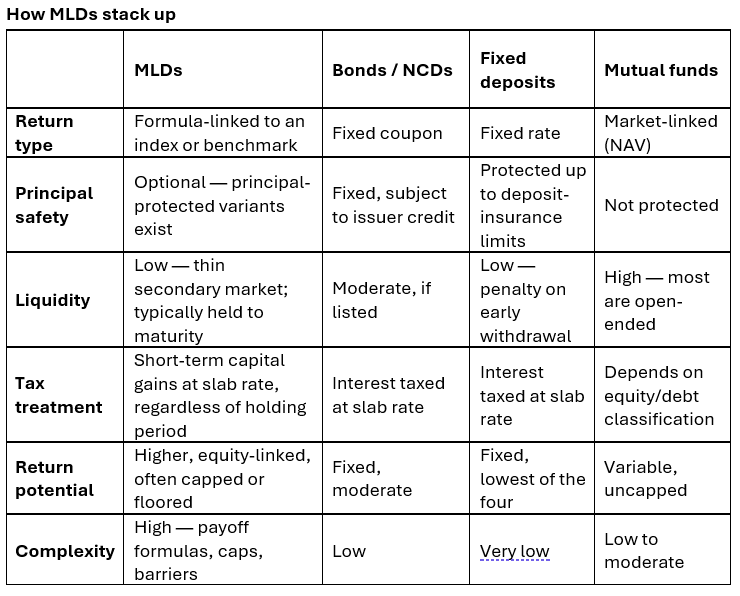
The trade-off is legible enough: MLDs offer a shot at equity-like returns with a partial safety net, in exchange for poor liquidity, higher complexity, and — since 2023 — no tax edge over the alternatives.
A tool for volatile markets, not a core holding
The clearest use case for MLDs today is tactical rather than strategic. When equity markets turn choppy, some investors sell part of their holdings and route the proceeds into a principal-protected MLD rather than into cash or a fixed deposit. The MLD then behaves as a kind of holding pen: capital is protected if the market falls further, but the investor retains some participation if it recovers before the debenture matures — at which point the money can be redeployed into equities, often at more attractive levels if markets have indeed corrected.
This is consistent with the broader direction of Indian wealth management going into 2026, where advisers describe a growing preference for portfolios that are resilient rather than aggressively positioned, after a period in which Indian equities underperformed global peers even as gold and silver rallied. Structured products, including MLDs, are increasingly discussed in the same breath as private credit and alternative investment funds — as instruments for managing volatility and dispersion, not as tax shelters.
What investors get wrong
A few misconceptions persist, often because they linger from the pre-2023 era:
“MLDs are tax-efficient.” They no longer are. All gains are taxed as short-term capital gains at slab rate, with no benefit for a longer holding period and no indexation.
“Principal-protected means risk-free.” The protection is only as good as the issuer. MLDs are unsecured claims on the company that issues them — if it defaults, the “protection” is worth nothing.
“MLDs behave like fixed deposits.” They don’t offer an assured return; what comes back at maturity depends entirely on the pre-set payout formula and how the benchmark has performed.
“Being listed makes them liquid.” Listing does not guarantee a ready buyer. Secondary-market trading in MLDs is typically thin, and early exit can mean selling at a significant discount, if a buyer can be found at all.
The risks worth weighing
Before investing, four risks deserve particular scrutiny:
Credit risk. MLDs are debt claims on the issuer, often a non-banking financial company. Investors should stay within their comfort zone on credit rating — AAA or AA-rated issuers for lower risk tolerance — since a default can wipe out the “protected” principal along with any expected return.
Liquidity risk. These instruments are built to be held to maturity. Investors who may need the capital early should treat MLDs as illiquid.
Payoff complexity. Caps, participation rates and barriers embedded in the payout formula can materially limit upside even when the underlying benchmark performs well. The offer document, not the marketing pitch, tells the real story.
Regulatory risk. The 2023 change is a reminder that tax treatment is not fixed. Rules can shift, and — as happened then — can apply retroactively to instruments already held.
Who should — and shouldn’t — hold them
MLDs are best suited to HNIs and sophisticated investors with a long investment horizon, the risk appetite to accept possible principal loss in non-protected structures, and the patience to hold to maturity. They can also serve first-time or more conservative investors through principal-protected structures, provided they invest with proper guidance given the complexity of the payout terms.
They are poorly suited to investors who may need liquidity before maturity, those in lower tax brackets where slab-rate taxation erodes much of the return advantage, or anyone unwilling or unable to evaluate issuer credit quality and payoff mechanics closely.
Where MLDs fit from here
Commentary from India’s private wealth industry heading into 2026 points to structured products, MLDs included, becoming a more settled — if still niche — feature of diversified HNI and UHNI portfolios, alongside private credit, alternative investment funds and offshore allocations. Their future growth looks tied less to tax advantages, which are gone, and more to product innovation — a widening range of underlying benchmarks, more customisable payoff structures — and to whether the industry can make the instruments accessible without obscuring their complexity and illiquidity from newer investors.
The investment case for MLDs, in short, has not so much strengthened as changed shape: from a tax trade dressed up as diversification, to a genuine — if still niche — diversification tool that happens to carry no tax advantage at all.
Sources
Vinod Kothari Consultants — “Shorn of tax benefit, MLDs now face tax deduction on payouts” — https://vinodkothari.com/2023/05/shorn-of-tax-benefit-mlds-now-face-tax-deduction-on-payouts/
Grip Invest — “Taxation of Market-linked Debentures (MLDs) in India” — https://www.gripinvest.in/blog/tax-implications-of-market-linked-debentures
InCred — “MLDs: Advantages and disadvantages” — https://www.incredpremier.com/blogs-details/mlds-types-features-and-benefits
PL Capital — “Market Linked Debentures – Invest in MLD Online in India” — https://www.plindia.com/market-linked-debentures/
Dezerv — “Market Linked Debentures – Find the list of all MLDs in India” — https://www.dezerv.in/bonds/mld-market-linked-debentures/
Anand Rathi PCG (ARPCG) — “Taxation on Market-Linked Debentures in India” — https://www.anandrathipcg.com/blogs/taxation-on-mlds
EquityUnlisted — “Market-Linked Debentures (MLDs) 2025 | Smart Fixed-Income Investment” — https://equityunlisted.com/market-linked-debentures-mlds/
Jiraaf — “Are Market Linked Debentures Worth It? MLDs Meaning, Tax & Returns” — https://www.jiraaf.com/blogs/personal-finance/market-linked-debentures-mlds
Meta Investment — “Earn More Than Traditional Fixed Income with Market-Linked Debentures” — https://metainvestment.in/2024/05/03/mld/
Meta Investment — “Market-Linked Debentures (MLDs)” — https://metainvestment.in/income/mld/
Tata Capital — “Market Linked Debentures (MLDs): Types, risks & taxation” — https://www.tatacapital.com/blog/wealth-services/understanding-market-linked-debentures/
Taxmann — “Market-Linked Debentures Investment – Impact of Finance Act 2023” — https://www.taxmann.com/post/blog/market-linked-debentures-investment-impact-of-finance-act/
Hubbis — “India 2026: Portfolio Discipline, Global Diversification And Advisory Depth In A Maturing Wealth Market” (Aditya Birla) — https://www.hubbis.com/article/india-2026-portfolio-discipline-global-diversification-and-advisory-depth-in-a-maturing-wealth-market
Hubbis — “From Product to Portfolio Solutions: Building Resilient Wealth Strategies for India’s Next Phase” (Motilal Oswal Private Wealth) — https://www.hubbis.com/article/from-product-to-portfolio-solutions-building-resilient-wealth-strategies-for-india-s-next-phase
Hubbis — “Nuvama Private’s Onkarpreet Singh Jutla on Global Diversification, Alternatives and Risk-Calibrated Growth for India 2026” — https://www.hubbis.com/article/nuvama-private-s-onkarpreet-singh-jutla-on-global-diversification-alternatives-and-risk-calibrated-growth-for-india-2026
Hubbis — “The Diversification of HNW and UHNW Portfolios in India” (Motilal Oswal AMC) — https://www.hubbis.com/article/the-diversification-of-hnw-and-uhnw-portfolios-in-india-views-from-a-leading-local-asset-management-expert
Hubbis — “Global Diversification Comes of Age: Building Cross-Border Investment Capability for Indian Wealth” — https://www.hubbis.com/article/global-diversification-comes-of-age-building-cross-border-investment-capability-for-indian-wealth
Hubbis — “India’s Asset & Wealth Management Crossroads: Incentives, Innovation and the Next Phase of Advisory Evolution” — https://hubbis.com/article/india-s-asset-wealth-management-crossroads-incentives-innovation-and-the-next-phase-of-advisory-evolution
Financier Worldwide — “The great portfolio rebalancing: a shift in diversification” — https://www.financierworldwide.com/the-great-portfolio-rebalancing-a-shift-in-diversification
IRJAEM — “Structural Transformation In India’s Wealth Management Industry: Trends, Growth Drivers, And Emerging Challenges” — https://goldncloudpublications.com/index.php/irjaem/article/view/1422