
Indices are supposed to be boring. They are meant to apply a fixed rule to a fixed universe of stocks and let the chips fall where they may, without a human in the loop to second-guess the result. So when the people who run an index decide to change the rule itself, it is worth asking why, and whether the new rule is actually better than the old one. NSE Indices, the subsidiary of India’s National Stock Exchange that built the Nifty 50 Value 20, has just done exactly that, and the answer is more interesting than the usual housekeeping notice would suggest.

The Nifty 50 Value 20 selects 20 supposedly cheap stocks from the Nifty 50, India’s blue-chip benchmark, and is tracked by six exchange-traded funds and index funds, together holding roughly ₹14.5bn (about $153m at current exchange rates) in net assets:
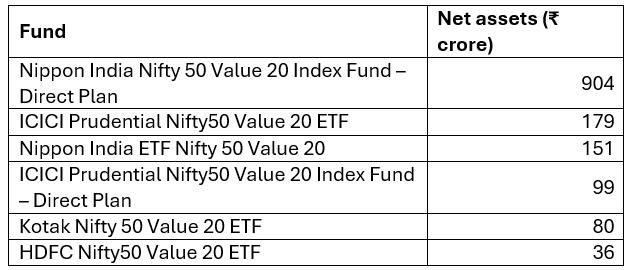
Nippon India’s index fund alone accounts for more than 60% of the total; the rest is split across smaller offerings from HDFC, ICICI Prudential and Kotak. On June 10th NSE Indices announced that the entire stock-selection formula behind the index would change, alongside its rebalancing schedule and the way it weights its constituents. The revision brings the Nifty 50 Value 20 into line with the Nifty 200 Value 30, a sister index with a wider, mid-cap-inclusive universe that already used the new approach. The result, effective from June 30th, is a meaningfully different index wearing the same name, and one that every rupee in those six funds is now obliged to follow.
What changed, in the accounting
The old formula scored each stock on four factors: return on capital employed (40% of the score), the price-to-earnings ratio (30%), the price-to-book ratio (20%) and dividend yield (10%). It also required stocks to comply with insurance-regulator dividend norms, a small but specific filter. The new formula drops that filter entirely and replaces the old ratios with four different ones, each weighted equally at 25%: earnings-to-price, sales-to-price, book-to-price and dividend yield.
This is a more substantial change than swapping one ratio for another. Return on capital employed measures how efficiently a company turns capital into profit; it says nothing about price. Earnings-to-price and book-to-price, by contrast, are inverted versions of the price-to-earnings and price-to-book ratios already in use, just expressed as yields rather than multiples. Sales-to-price is genuinely new to this index, screening for revenue generated per rupee of market value, a metric that tends to favour low-margin, capital-intensive businesses such as commodity producers and utilities over asset-light ones such as consumer brands or software firms. Dropping return on capital employed removes the only factor that had anything to do with how well a business is actually run; the new four-factor set is concerned purely with how cheap a stock looks relative to its fundamentals, with no allowance for the quality of those fundamentals.
The weighting change compounds this. Under the old scheme, return on capital employed counted for nearly half the score, meaning a company had to be both profitable and statistically cheap to qualify. Under the new scheme, all four ratios count equally, which mechanically gives more weight to a single cheap statistic, since no other measure can offset it. A stock with a rock-bottom price-to-book ratio because the market suspects its assets are about to be written down can now score just as well as one that is cheap and fundamentally sound.
Three further changes accompany the scoring overhaul. The number of stocks guaranteed a place in the index regardless of score, the “compulsory inclusion” list, doubles from the top five to the top ten, which loosens the index’s grip on its highest-scoring names and makes the bottom half of its 20 holdings more sensitive to the new formula. The review and rebalancing calendars, previously annual and quarterly respectively, both move to a shared semi-annual cycle in June and December, which means the index will be reconstituted less often than before. And the weighting methodology shifts from plain free-float market capitalisation to what NSE calls “tilt” weighting, multiplying free-float market capitalisation by the value score, so a company that is both large and cheap by the new metrics gets a disproportionately larger slice of the index than its market value alone would justify.
The reshuffle that followed
The practical effect showed up immediately in the index’s holdings. Bajaj Auto, Cipla, Dr Reddy’s Laboratories, Maruti Suzuki and Tech Mahindra were dropped; Bajaj Finserv, Grasim Industries, HDFC Bank, Reliance Industries and Tata Steel took their places. None of those exits were forced by any change in the companies’ underlying business. They left because a different formula, applied to the same set of companies on the same day, produces a different ranking. That is the clearest illustration of what a methodology change actually does: it does not discover new information about which companies are cheap, it redefines what “cheap” means.
The case for the change
The strongest argument for the new approach is consistency. With the Nifty 50 Value 20 and Nifty 200 Value 30 now sharing one formula, NSE has a single, simpler story to tell investors about what “value” means across its suite of indices, rather than maintaining two competing definitions that could, in principle, recommend opposite things about the same stock. Earnings-to-price and book-to-price are also more conventional value metrics internationally than return on capital employed, which is more commonly associated with quality-factor investing; aligning with standard usage makes the index easier to benchmark against global value indices and academic factor research. The shift to semi-annual rebalancing, meanwhile, should reduce portfolio turnover and the trading costs that come with it, a genuine benefit for anyone holding the index through a fund.
The case against
The drawbacks are not trivial. Removing return on capital employed strips out the index’s only check on business quality, leaving a pure-price screen that is more exposed to value traps, companies that are cheap because the market has correctly priced in genuine trouble, not because it has made a mistake. Equal-weighting the four remaining ratios, rather than letting profitability dominate as before, makes that risk somewhat more acute: a structurally troubled company can no longer be filtered out by a poor score on capital efficiency, since that factor is no longer part of the test. The doubled compulsory-inclusion list and the new tilt-weighting scheme also mean the index’s composition is now less purely a function of valuation and more a function of size multiplied by valuation, which can quietly increase concentration in already-large stocks. And the move to less frequent rebalancing cuts both ways: lower turnover is good for costs, but it also means the index reacts more slowly when a stock’s genuine value characteristics change, whether for better or worse, leaving investors exposed to a stale snapshot for longer between reviews.
None of this makes the new methodology wrong. It is a coherent, internationally conventional way to define a value index, and it is now consistent across two of NSE’s products rather than one. But anyone holding a fund that tracks the Nifty 50 Value 20 should understand that the index they own changed in substance on June 30th, not just in its list of holdings. The ratios behind the name, not merely the names inside it, are what determine what kind of “value” an investor is actually buying.