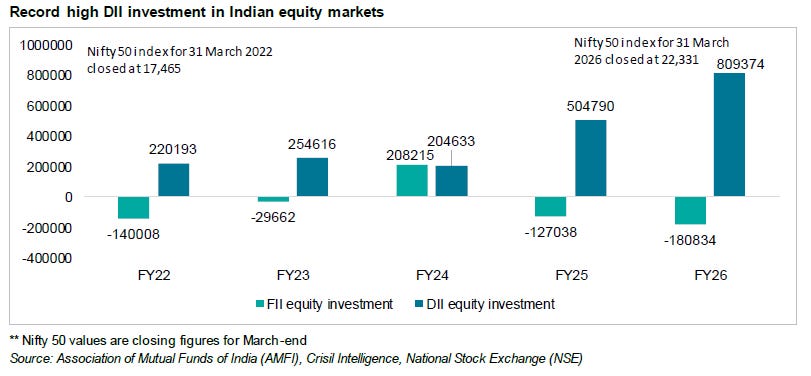
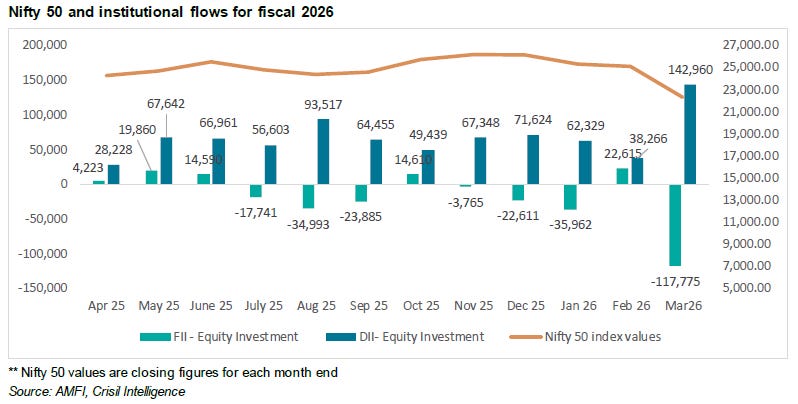
Fiscal 2026 gave Indian equities a lesson in contrasts. The Nifty 50 spent much of the year drifting between 23,000 and a high of 26,000, briefly touched in November and December 2025, before a sharp reversal dragged it down to close the fiscal at 22,331. March 2026 delivered the cruellest blow: an 11.31% single-month fall, the steepest since March 2020, as escalating tension in West Asia rattled global markets and wiped out a substantial slice of market capitalisation.
The proximate trigger, as reported at the time, was the conflict involving Iran, Israel and the United States, which pushed crude oil prices sharply higher and sent India’s VIX volatility gauge — the market’s so-called fear index — from below 12 to a peak of 28.9 by 30 March, before it eventually retreated. According to Outlook Business, foreign portfolio investors swung from net inflows of roughly $2.5 billion in February to net outflows of nearly $6 billion by mid-March, and new investor registrations on Indian exchanges fell 24.5% month-on-month — the steepest such drop of the financial year, suggesting that while mutual funds kept buying, the flow of fresh retail money into direct equity slowed sharply during the worst of the panic.
What made the year noteworthy was not the fall itself but who did the buying while foreign investors did the selling. Foreign portfolio investors (FPIs) sold Indian equities worth Rs 1.81 lakh crore over the fiscal. Domestic institutional investors (DIIs), led overwhelmingly by mutual funds, absorbed that pressure and then some, investing a record Rs 8.09 lakh crore — comfortably the highest figure in at least five years, and roughly four times the previous year’s DII total of Rs 5.05 lakh crore.
Mutual funds’ own contribution to that domestic buying was substantial: net equity inflows into mutual funds stood at Rs 3.47 lakh crore for the fiscal. March 2026 marked the 61st consecutive month in which mutual funds recorded positive net equity inflows — a streak that has now run through multiple market corrections and several bouts of foreign capital flight without breaking.
The mechanics of this shift are visible month by month. Foreign investors turned net sellers in July, August, September, October, December and, most emphatically, March 2026, when they pulled out Rs 1,17,775 crore in a single month — by far the largest monthly outflow of the year. Domestic institutions were net buyers in every single month bar none, and in March, as foreign money fled, DII buying actually accelerated to Rs 1,42,960 crore, comfortably its highest monthly figure of the fiscal.
This is not simply a story of resilience; it is a structural change in who sets the marginal price of Indian equities. Five years ago, in fiscal 2022, DIIs invested Rs 2,20,193 crore against FPI outflows of Rs 1,40,008 crore — already domestic-dominated, but at roughly a third of this year’s scale on the DII side. For retail investors, the practical implication is that systematic domestic flows now provide a buffer against foreign-flow volatility that did not exist at anything like this scale even three years ago. Whether that buffer holds in a genuinely sustained downturn, rather than a single bad month, remains untested. But fiscal 2026 was as close to a live-fire drill as Indian markets have had in years, and the buffer held.