
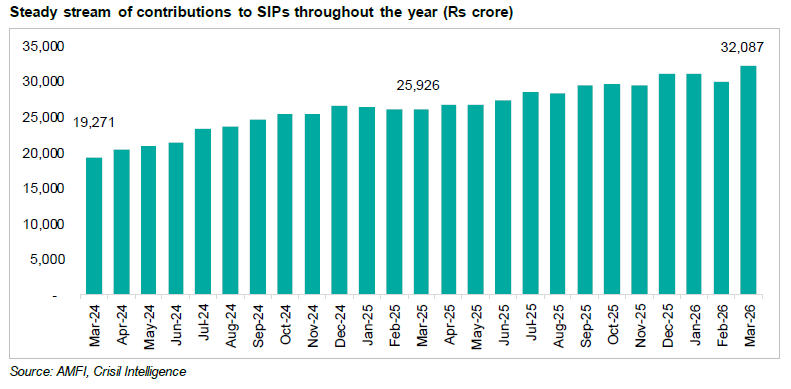
If fiscal 2026 tested the nerve of Indian retail investors, the systematic investment plan (SIP) numbers suggest that nerve held. Annual SIP contributions - excluding flows into funds of funds investing overseas - rose 19% to Rs 3.40 lakh crore, from Rs 2.86 lakh crore in fiscal 2025, an absolute increase of Rs 54,227 crore.
The monthly pattern is the more telling detail. Contributions crossed Rs 26,000 crore in the very first month of the fiscal, reaching Rs 26,632 crore in April 2025, and climbed steadily from there. December 2025 and January 2026 set a then-record of Rs 31,002 crore. Then came March 2026 - the same month in which the Nifty 50 fell 11.31%, its steepest monthly decline since March 2020 - and SIP contributions rose to an all-time high of Rs 32,087 crore.
Part of that resilience is generational. According to a review compiled by HDFC Securities, the share of stock-market investors below the age of 30 rose from 22.6% in March 2019 to 38.4% by February 2026, alongside a broader rise in demat accounts to roughly 21-22 crore nationally - a cohort that industry commentary generally links to digital-first onboarding and a preference for automated, recurring investment over discretionary stock-picking, which fits naturally with the SIP format.
Widening that base further is a specific policy push. AMFI, working with SEBI, introduced “Choti SIP” - a systematic investment plan with a minimum monthly contribution of Rs 250 - reportedly launched at an event attended by the SEBI chairperson specifically to reach first-time investors who might otherwise find conventional SIP minimums out of reach. As described in industry trade coverage, the product carries a minimum five-year (60-instalment) commitment, is capped at three such SIPs per investor across three fund houses, and is restricted to growth-plan equity schemes outside the sectoral, thematic, mid-cap and small-cap categories - with distributors reportedly eligible for a modest incentive once an investor completes 24 instalments, an inducement designed to make it worth an adviser’s time to bring in small first-time savers rather than only larger tickets.
The number of contributing SIP accounts rose to 9.72 crore in March 2026, from 8.11 crore a year earlier - a net addition of 1.61 crore active accounts. SIP assets under management reached Rs 14.83 lakh crore, maintaining a 20% share of total industry AUM (20.11%, against 20.09% a year earlier).
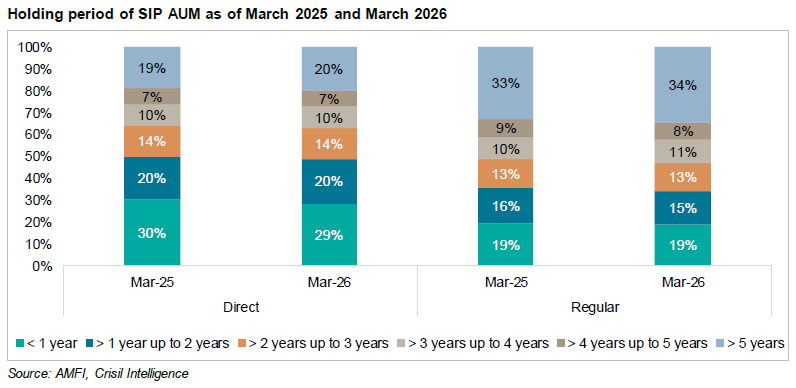
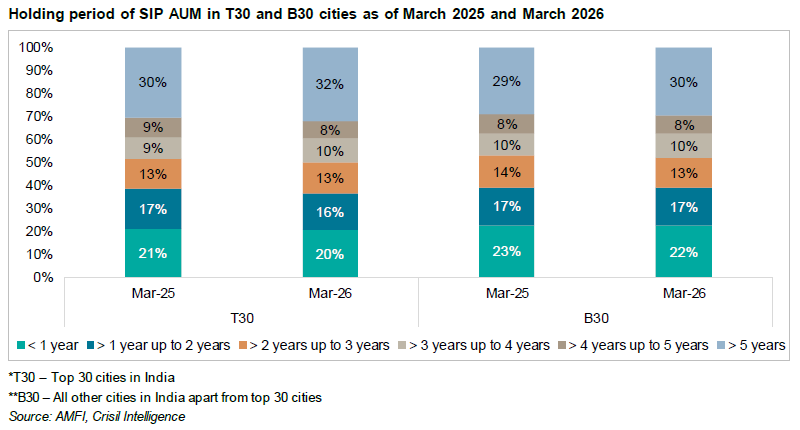
Perhaps the more interesting evidence of investor patience sits in the holding-period data. Within direct plans, the share of SIP assets held for more than five years rose to 20% in March 2026, from 19% a year earlier, while the share held for less than a year contracted to 29%. Regular plans - where an intermediary or adviser is typically involved - show an even more pronounced long-term tilt: 34% of SIP AUM held for more than five years, against just 19% held for under a year. Both India’s top-30 cities and the rest of the country recorded the same rising share of assets held beyond five years between March 2025 and March 2026, with B30 towns showing marginally higher long-term holding shares than the metros throughout - a reminder that patience is not solely a big-city phenomenon.
Sources:
AMFI Annual Report: Fiscal 2026
Cafemutual, “AMFI launches choti SIP or Rs.250 SIP” - https://cafemutual.com/news/industry/34255-amfi-launches-choti-sip-or-rs250-sip
Cafemutual, “All you need to know about the newly launched Choti SIP” - https://cafemutual.com/news/industry/35491-all-you-need-to-know-about-the-newly-launched-choti-sip
HDFC Securities (Big Review, via HDFC Sky), “Retail Participation Soars as Demat Accounts Hit Record” - https://hdfcsky.com/blogs/media-coverage/retail-participation-and-liquidity-trends-reshape-market-structure