
For more than two decades, Wockhardt has pursued a goal that many of the world’s largest pharmaceutical companies gradually abandoned: discovering entirely new antibiotics.
At a time when antimicrobial resistance is emerging as one of the most serious threats to global healthcare, the company finds itself holding a portfolio of novel molecules that could potentially address infections that are becoming increasingly resistant to existing treatments. The debate today is no longer about whether Wockhardt can discover new drugs. Instead, the real question is whether it can successfully convert years of scientific achievement into a sustainable and profitable business.

From Generic Medicines to Drug Discovery
Like most successful Indian pharmaceutical companies, Wockhardt’s journey began with generic medicines. Over the years, however, the company steadily evolved beyond manufacturing and marketing pharmaceuticals.
Founded by Dr. Habil Khorakiwala, Wockhardt expanded into biotechnology, vaccines, insulin products and, most notably, novel antibiotic research. Today, the company operates manufacturing facilities across India, the United Kingdom and Ireland, maintains research centres in both India and the UK, and generates a significant share of its revenue from international markets.
By FY25, Wockhardt reported revenue of approximately ₹3,033 crore and EBITDA of ₹418 crore. Management described the organisation as a “global research-driven multinational” with businesses spanning pharmaceuticals, biotechnology and innovative anti-infective therapies.
What differentiates Wockhardt from many of its peers is its willingness to commit substantial capital and resources to original drug discovery. Even during periods marked by regulatory challenges, financial stress and weak profitability, the company continued investing in antibiotic research.
That persistence now sits at the heart of the investment thesis.
The Long Journey: A Decade of Challenges Before Recovery
The company’s journey over the last decade can broadly be divided into four distinct phases.
Phase I: Building a Global Pharmaceutical Business
Until the middle of the previous decade, Wockhardt resembled many successful Indian pharmaceutical exporters. It possessed a growing international presence, manufacturing facilities across multiple geographies, a strong branded pharmaceutical franchise and ambitious research programmes.
Behind the scenes, however, management was also building one of the world’s largest antibiotic discovery platforms outside the traditional pharmaceutical giants.
Phase II: Regulatory and Financial Stress
The period between FY2016 and FY2020 proved particularly challenging. USFDA observations affected key manufacturing facilities, profitability deteriorated sharply, debt levels increased and several years were marked by weak or negative earnings.
Despite these pressures, management chose to continue funding research programmes. At the time, many investors questioned whether the antibiotic pipeline would ever generate meaningful returns. Looking back, this was arguably the most difficult phase in the company’s modern history.
Phase III: Repairing the Balance Sheet
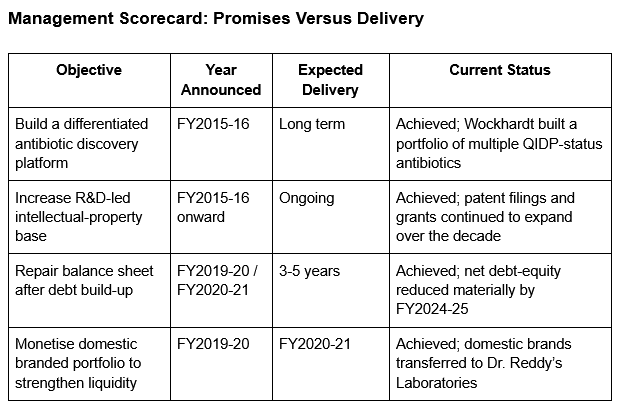
A major turning point came when Wockhardt sold a portfolio of domestic brands to Dr. Reddy’s Laboratories. The transaction helped reduce debt, strengthen liquidity, fund ongoing research and improve overall financial flexibility.
At the same time, management undertook a significant restructuring of the US business.
In February 2023, Dr. Murtaza Khorakiwala explained:
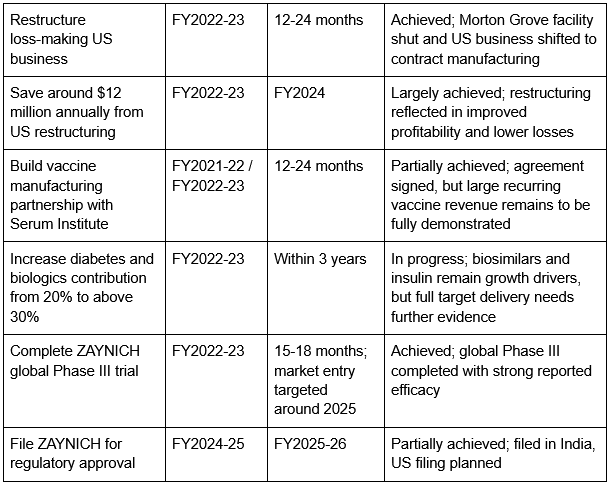
“Next slide, we have been mentioning over the last one year that the US business needs to get significantly restructured. And as it was having a significant amount of drain into the financial performance of the company, we have shut down our manufacturing facility at Morton Grove near Chicago and using a simple 80-20 formula, we have identified the product portfolio to be manufactured by a third party and that will be an ongoing continuing business that we will have. As a result of the entire restructuring of the manufacturing, we intend to save about $12 million in losses which we are currently incurring and however we will continue to maintain our sales in the US business as these products will be manufactured from a third party certified facility with approximately 40% gross margin”. —Dr. Murtaza Khorakiwala, Managing Director, Investor Call Transcript, 21 February 2023
The closure of the Morton Grove manufacturing facility and the shift towards outsourced production significantly improved profitability while allowing the company to maintain its presence in the US market.
Phase IV: Commercialisation Begins
The latest phase may prove to be the most important. Wockhardt’s focus has gradually shifted from drug discovery to commercialisation.
For the first time, investors can evaluate not only scientific progress but also the commercial opportunities emerging from the company’s research pipeline.
What Makes Wockhardt Different?
Wockhardt’s greatest strength does not lie in manufacturing, branding or even its global footprint. Instead, it lies in the antibiotic discovery platform that the company has spent nearly two decades building.
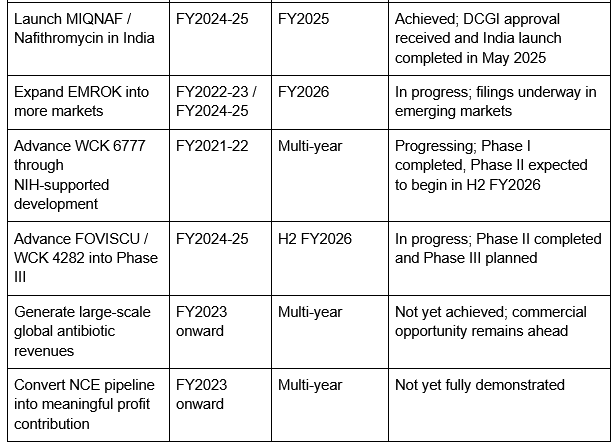
The company continued investing in solutions for antimicrobial resistance long after many global pharmaceutical companies reduced their focus on the area. That persistence has resulted in a portfolio that includes:
- ZAYNICH (WCK 5222)
- Nafithromycin (Miqnaf)
- WCK 6777
- WCK 4282
- Multiple other anti-infective assets
Beyond antibiotics, Wockhardt possesses several additional advantages.
Diversified Global Operations
The company derives a majority of its revenues from international markets and maintains meaningful positions in the UK and Ireland.
Biotechnology Platform
Its insulin and biosimilar businesses continue to provide diversification beyond traditional pharmaceuticals.
Improved Balance Sheet
Perhaps the most underappreciated achievement of recent years has been the improvement in financial health. Net debt-equity has declined significantly, reducing financial risk and improving strategic flexibility.

Source: Moneycontrol — https://www.moneycontrol.com/financials/wockhardt/ratiosVI/w05
Significant Intellectual Property
Decades of research have enabled the company to build a substantial intellectual property portfolio comprising thousands of patents. According to their website, “Till date, we have filed 3,037 patents cumulatively, and have been granted 628 patents.”
– https://www.wockhardt.com/about-us/research-and-development/ (10-Jun-2026)
Entering a New Phase of Growth
Unlike commodity businesses, pharmaceutical companies do not operate through traditional economic cycles. Instead, they move through product-development cycles.
Management commentary increasingly suggests that Wockhardt is transitioning from the discovery phase into the commercialisation phase of its innovation journey.
This distinction is important.
For most of the past two decades, the company’s future depended on scientific validation. Today, much of that science appears to have been validated. The next challenge is commercial execution.
Management has consistently indicated that the coming years will focus on regulatory approvals, product launches, physician adoption, international commercialisation and scaling revenues from novel antibiotics.
Risks Investors Should Not Ignore
Despite its strengths, Wockhardt remains a business with meaningful risks.
Commercialisation Risk
Scientific success does not automatically translate into commercial success. While the company has demonstrated its ability to discover drugs, it must now prove that it can build profitable global franchises around them.
Regulatory Risk
Like all pharmaceutical companies, Wockhardt remains exposed to inspections, approvals and evolving regulatory requirements. Its history demonstrates how significant regulatory setbacks can affect business performance.
Concentration Risk
A substantial portion of future value creation depends on a relatively small number of molecules. Any major setback in commercial launches could materially affect long-term outcomes.
Long Development Timelines
Drug discovery remains an inherently uncertain process, requiring patience and a willingness to accept timelines that are often much longer than those of conventional pharmaceutical businesses.
Management: Persistence as a Competitive Advantage
One of the strongest arguments in favour of management is consistency.
Many management teams alter their strategy when faced with setbacks. Wockhardt chose a different path. Despite regulatory issues, rising debt, weak profitability and investor scepticism, management continued funding its antibiotic programmes.
That persistence increasingly appears justified. The company’s debt reduction efforts, US restructuring and clinical progress indicate a management team capable of executing difficult long-term plans. At the same time, persistence can become a weakness if it limits strategic flexibility. The coming years will reveal whether management can be as effective at commercial execution as it has been at scientific development.
Succession: A Planned Transition
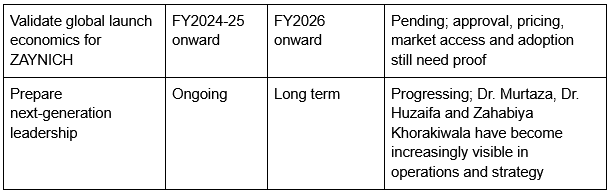
Historically, Wockhardt was closely associated with founder Dr. Habil Khorakiwala. Over time, greater responsibilities have been assumed by Dr. Murtaza Khorakiwala, Dr. Huzaifa Khorakiwala and Zahabiya Khorakiwala.
The transition appears deliberate rather than reactive. Investor presentations and annual reports increasingly feature second-generation leadership discussing operational and strategic priorities.
By 2026, Zahabiya Khorakiwala was directly involved in presenting the US strategy for ZAYNICH, suggesting that succession planning is already being executed rather than merely discussed.
Watchlist or Active Research Candidate?
A few years ago, Wockhardt was primarily viewed as a turnaround story. Today, the narrative appears different. Over the last several years, the company has reduced debt, improved profitability, advanced its research pipeline, demonstrated management execution, initiated leadership transition and moved closer to commercialising its innovation platform.
The central risk is no longer survival. The central question is monetisation.
For investors who maintain strict valuation discipline, Wockhardt increasingly appears worthy of active research rather than passive observation. Several important hurdles have already been crossed. The next hurdle, commercial success of its innovation platform, may prove to be the most consequential of all.
Conclusion
Most pharmaceutical companies spend their lives manufacturing medicines discovered by others. Wockhardt spent more than two decades attempting to discover its own.
That decision created years of financial strain, regulatory challenges and investor frustration. It also produced a portfolio of intellectual property that few Indian pharmaceutical companies possess.
After years of investing in research while repairing its balance sheet, Wockhardt appears to be approaching a pivotal phase in its evolution. The science appears increasingly validated, the balance sheet is considerably stronger and the next generation of leadership is steadily taking on greater responsibility.
What remains is commercial execution.
The next five years are likely to be decisive. If Wockhardt succeeds in commercialising its novel antibiotic portfolio, the company may ultimately be remembered not merely as another pharmaceutical manufacturer, but as one of the few Indian healthcare businesses that successfully built a globally relevant innovation platform from the ground up.
For different styles of investing, the read on this stock looks different.
Value Investor — There are two extreme views a value investor could take here. From a pure ratio perspective, the stock would likely be rejected outright, not even making it onto an active watchlist. A more contrarian value approach, however, might see this differently and consider it worth tracking.
Growth Investor — EPS growth has only just turned positive after ten years of decline. A growth-oriented investor would likely view this as early-stage and worth adding to a watchlist to track whether the trend holds.
Momentum Investor — Momentum investing is rules-based by design — the signal itself, not personal judgement, is what typically drives entry decisions for this style. Whether this stock fits depends entirely on the specific rules and indicators an individual momentum strategy uses.
Disclaimer
This article is prepared solely for informational and educational purposes and should not be construed as investment advice, research advice, a recommendation, solicitation or an offer to buy or sell any security. Readers should conduct independent due diligence and seek advice from a registered financial adviser, tax adviser, accountant or other qualified professional before making investment decisions. Past performance, management commentary and industry trends do not guarantee future results.
Food for thought:
There are many ways to build a position, and different investing styles tend to approach it differently. Value and growth investors often build positions gradually, in multiple tranches, rather than all at once — a practice that spreads entry-price risk over time. Momentum-oriented approaches tend to use smaller position sizes per stock, reflecting the higher turnover and risk typically associated with that style.
What’s “right” depends entirely on an individual’s risk appetite, time horizon, and overall portfolio construction — none of which can be assessed from a single article. This is exactly the kind of decision worth discussing with a SEBI-registered Investment Adviser, who can assess your specific situation before any position sizing approach is applied.