
The World Gold Council’s February 2026 report opens with a striking contrast. Cross-asset returns in 2025 were “surprisingly solid”, with disruptions from US tariffs and geopolitical shocks proving short-lived. Much of the strength has been attributed to a resilient global economy and optimism around artificial intelligence. Yet the report cautions that risk assets are sitting at “uneasy highs” against a backdrop of global turmoil. Stretched valuations and persistent macro risks, it argues, demand caution even as consensus growth forecasts remain robust. In short, markets look confident. The environment beneath them looks less so.
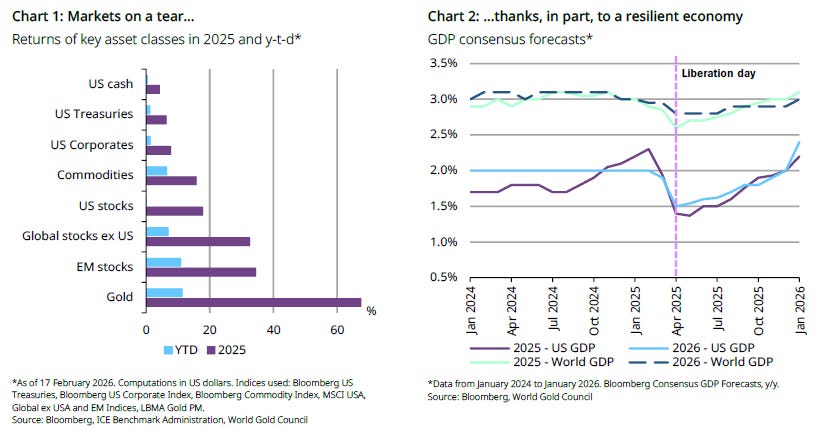
These charts show broad-based gains and stable growth expectations. Yet the strength of returns sits awkwardly against a world marked by geopolitical tensions, tariff uncertainty and policy shifts. The report argues that risk assets are trading at uneasy highs. Valuations are stretched. Credit spreads are tight. Optimism is widespread.
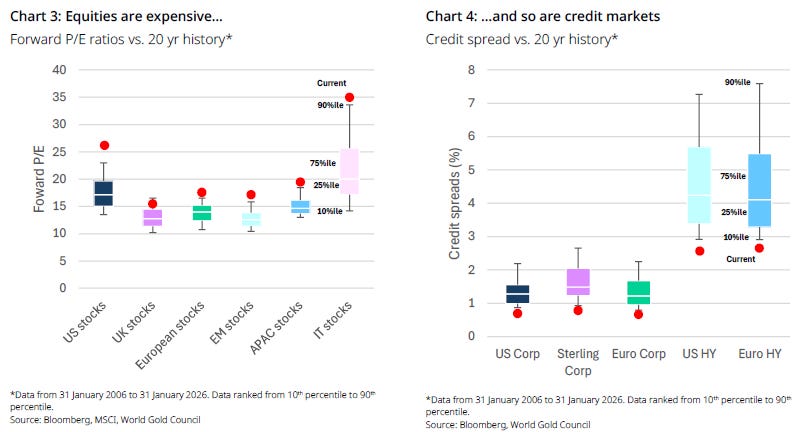
Forward price-to-earnings ratios are elevated relative to their 20-year history. Credit spreads are compressed. Neither condition guarantees an imminent correction. But both reduce the margin for error. When markets are priced for stability, even modest shocks can trigger outsized volatility.
The more troubling signal is behavioural. Investor conviction in growth appears firm, even as economic policy uncertainty remains elevated. That disconnect has historically been fertile ground for volatility. Gold’s strong performance in recent years reflects this mismatch.
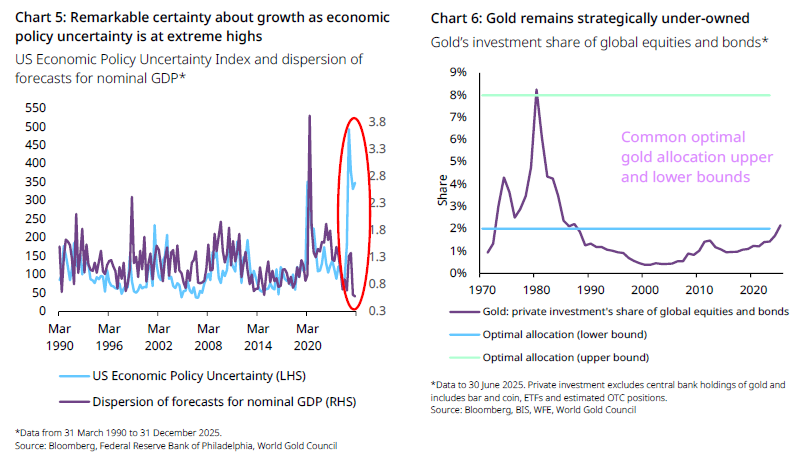
Despite its rally, gold remains under-owned relative to historical optimal allocation ranges. In other words, positioning does not look crowded on a strategic basis. That matters if investors begin to reassess risk.
Inflation presents another fault line. Core US inflation remains sticky and the output gap suggests limited slack in the economy. If inflation re-accelerates, central banks may have less room to ease. Bond markets, which many investors rely on for diversification, may not provide the same protection they once did.
The stock–bond correlation has shifted in recent years. In periods of stress, bonds have not always cushioned equity drawdowns as reliably as in the past. In such an environment, the case for alternative diversifiers strengthens.
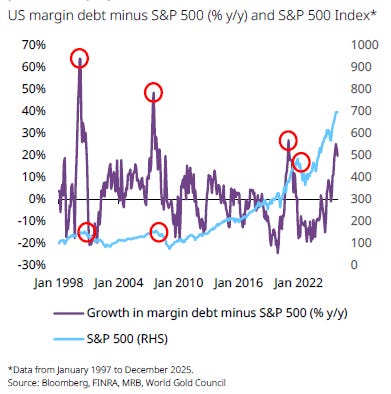
Equity market leverage is another concern. US margin debt has surged alongside the market. While rising margin debt does not automatically signal a peak, excessive increases have historically preceded periods of instability.
Leverage magnifies both gains and losses. If earnings disappoint or policy surprises emerge, unwinding leveraged positions could amplify downside moves. In such episodes, safe-haven demand typically rises.
Gold’s historical record during crises reinforces this point. Even after periods of strong prior returns, it has tended to provide resilience during market stress. It has generated positive returns in multiple crisis episodes while equities declined, and it has reduced overall portfolio drawdowns.
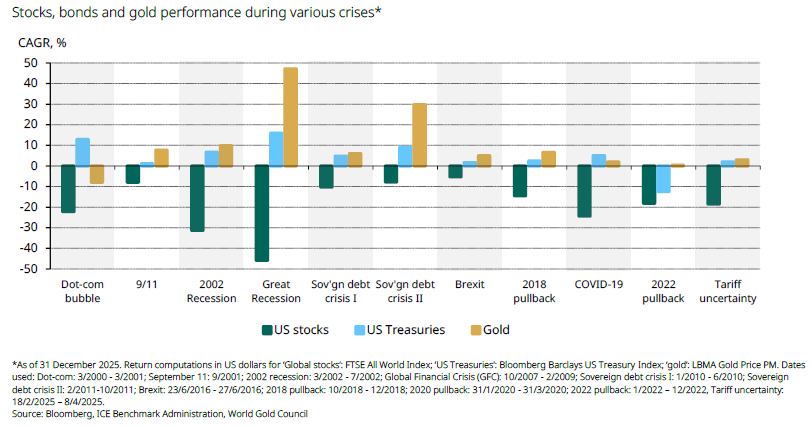
The central message is not that a crisis is inevitable. Nor is it that equities cannot continue higher. Rather, it is that the balance of risks has shifted. Valuations are full. Inflation risks linger. Policy uncertainty remains high. Leverage is rising.
In that context, gold’s role as a strategic asset becomes relevant again. It offers diversification when correlations shift. It can hedge inflation risk if price pressures re-emerge. And it has historically mitigated portfolio losses during systemic stress.
The case for 2026 is therefore not built on fear alone. It rests on portfolio construction. When markets are priced for perfection, resilience matters more than return chasing. Gold, even after a strong run, may still deserve a place at the core of long-term asset allocation.